Recovering Jewish History
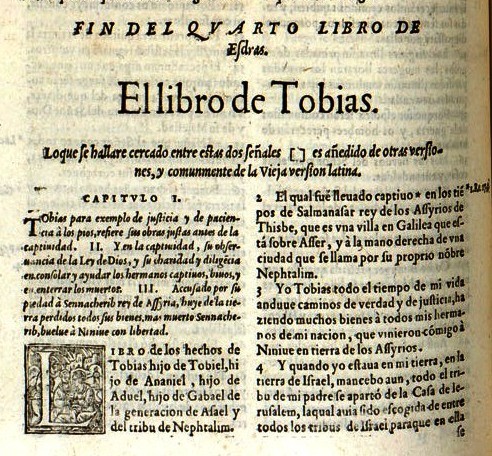 Publisher’s Weekly has written about the forthcoming Outside the Bible: Ancient Jewish Writings Related to Scripture. Here’s an excerpt:
Now his decades of knowledge–combined with those of his co-editors Louis H. Feldman and James L. Kugel—are on display in Outside the Bible: Ancient Jewish Writings Related to Scripture (Jewish Publication Society/Univ. of Nebraska Press, Dec.), an imposing three-volume set coming in at more than 3,300 pages (see “The Quest for Paul,” PW, Oct. 7, 2013). The volume, supported by two research grants from the National Endowment for the Humanities, includes Schiffman’s own new translation of the Temple Scroll, “which presents a plan for a new Temple and its sacrifices,” Schiffman says.
Choosing the more than 70 contributors ended up being less difficult than anticipated, says Schiffman: “Amazingly, we were always able to find good scholars in whom we had confidence.” The editors divided texts according to their major interests, with a few exceptions where particular texts required the attention of “one or a number of us because of our relationships to individual authors.”
Read the full article – Recovering Jewish History: Lawrence H. Schiffman
See also: The Significance of Outside the Bible
The Significance of Outside the Bible
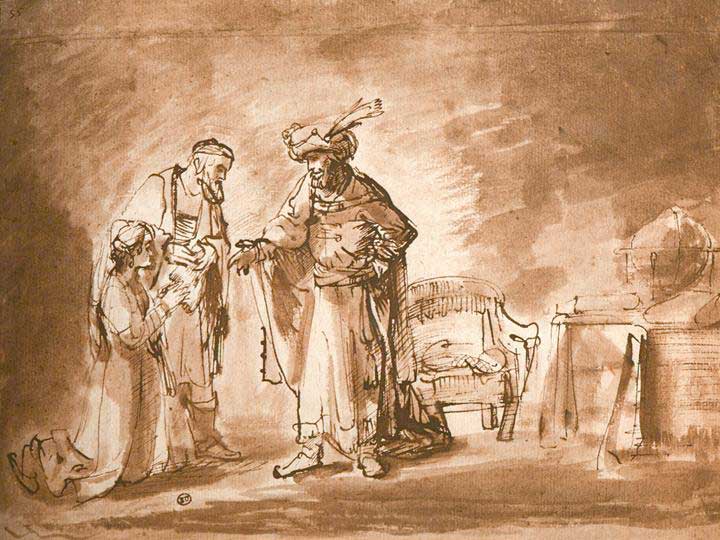
Esther Presented to Ahasuerus, Rembrandt (1606-1669), courtesy of cojs.org
Outside the Bible will be published this fall and and can be preordered from University of Nebraska Press. In honor of the upcoming publication, a bit about the significance of the Apocrypha, Pseudepigrapha, Hellenistic Jewish literature and the Dead Sea Scrolls:
One of the most significant characteristics of Second Temple Judaism is the wide variety of texts that circulated among different groups of Jews. We are accustomed to treating these documents in classes, based more on their transmission than their literary and theological characteristics. So we speak of Apocrypha, Pseudepigrapha, and Dead Sea Scrolls, designating in the first and last instance specific groups of texts collected in some way in Antiquity. Pseudepigrapha is a catch-all term which has been used increasingly loosely in recent years. Taken together, we gain from all these texts a picture of a Jewish community, both in and outside of the Land of Israel, producing all kinds of literary works and involved in vigorous debate about all kinds of religious questions. Outside the Bible presents a wide variety of these texts classified by their content and literary character, not by the ancient… Continue reading
How to Study a Dead Sea Scrolls Text: The Context of the Scrolls
There seems to be a general understanding of the context in which we study the Scrolls but it seems to remain unarticulated. This should be readily apparent since we have been witness to an absurd debate regarding the archaeological evidence that has in fact obscured the real questions that need to be discussed about the significance of the archaeological context. But I will leave this area as it is not my area of expertise.
Rather, I want to talk about what I would call the interpretive context. By this I refer to the problem that we all face with the various types of parallel materials we cite, namely Hebrew Bible, Second Temple Texts, New Testament and Rabbinic literature, to name the significant ones. I do not mean here to suggest that we are following wrong approaches, but rather that we are often not sufficiently self-aware or, alternatively, we are afraid to use these sources despite their being almost always the key to understanding our texts.
That most Qumran texts, whether sectarian or not, are highly dependent on what we call biblical texts is unquestionable. From my point of view, this dependence is one of the… Continue reading